A block on a rough slope
A block of mass is released from rest at the top of a rough slope of length , inclined at angle to the horizontal. The coefficient of friction between the block and the slope is , where .
(a) Find the speed of the block when it reaches the bottom of the slope.
Run the way your university runs it
Tell us where you're applying and you practise with that university's interviewer: its length, how it opens, how hard it pushes.
 University of Cambridge30 minutes, straight into a problem that builds up in steps.Interviews 7 to 18 December,
 University of Oxford25 minutes, like a tutorial: a warm-up question, then a problem.Online interviews from 7 December,
 Imperial College London25 minutes with one academic. Starts with why the course, then a problem.Each department sets its own, November to March
Course by course, from each university's own admissions pages. All the dates. Not affiliated with any of these universities.
On your own, the hints only tell you as much as you ask
Tap the method you're trying (energy, forces, momentum) and how far you've got. First it says whether that method will work. Ask again for a nudge, and a third time for the next step. The list of methods is the same on every problem, so seeing it gives nothing away.
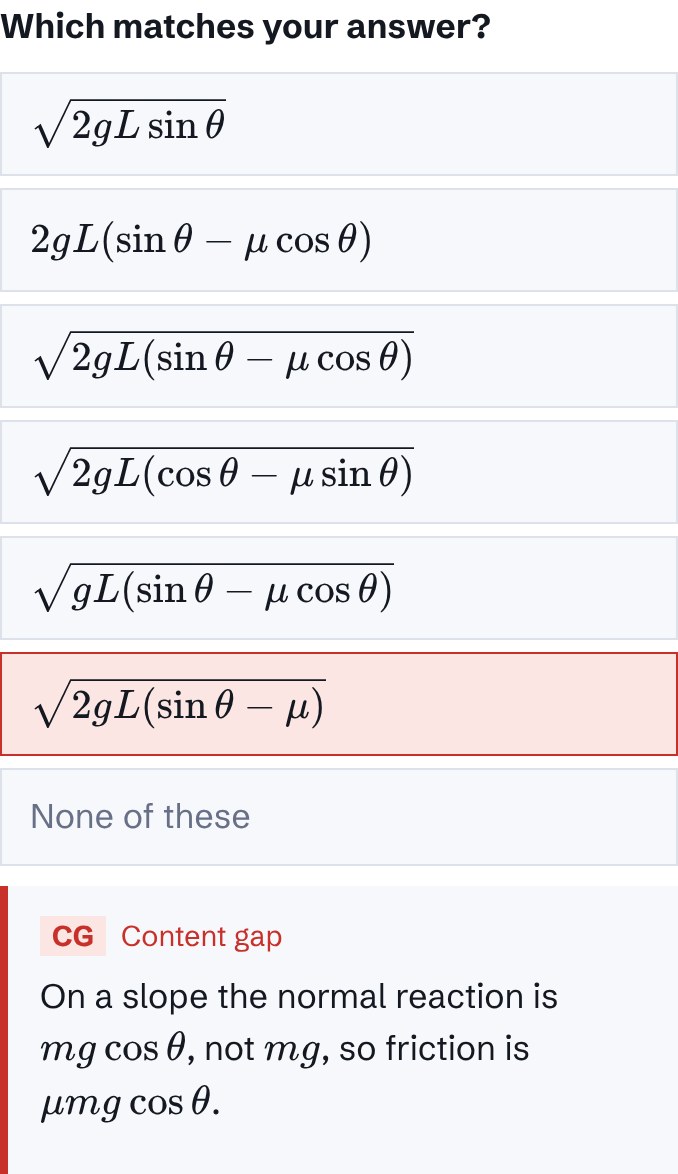
Answers are picked from a short list where every wrong option is the result of a common slip. Choose one and it tells you which slip: on the slope problem, using mg for the normal reaction instead of mg cos θ.
What it costs
- Every problem, with hints and worked solutions
- Free with an account
- Your first AI interview, a 10-minute taster
- Free
- Full-length AI interviews, 20 to 30 minutes like the real ones
- £6 each, down to £4.50 in a pack of 10
The interviewer costs money because the voice model is paid for every minute it runs. Pricing · How it works
Why this exists
I made this while doing my own applications. There's plenty of practice for the admissions tests, and almost none for the interview. The choices were a tutor (one company charges £595 for five mock interviews) or lists of past questions with the answer printed straight underneath, which you can't help reading.
What actually helps is working a problem you haven't seen, out loud, and being nudged when you stall. That's what this copies.
Questions
- Is it all right to practise with AI?
- Before the interview, yes. During it, no: Oxford, for example, asks candidates to agree not to use AI tools in their interviews. Check what your own invitation says.
- Will I get these questions?
- Almost certainly not. The point is getting used to working on something you haven’t seen while someone watches and asks why.
- Do I need an iPad?
- It’s nicest with an Apple Pencil, but a mouse or trackpad works. For the interviewer you need a microphone; headphones help.
- Where do the problems come from?
- They’re written for the site, not copied from past papers. Each one is solved again separately before it goes up, and if the two answers don’t match it doesn’t go up.
- Do my universities even interview?
- Many don’t for maths, physics and engineering. When you sign up you say where you’re applying, and the site only offers interviewers for courses that really interview.